Image by fdtate via FlickrOn a typical NASCAR race weekend, Sprint Cup drivers will get some
practice time in and qualify Friday, followed by more practice Saturday
and the race on Sunday. Crewmembers can set up the cars for qualifying,
then dial in a race setup. For an impound race, NASCAR usually shifts
to Saturday qualifying, then impounds the cars from after qualifying
until the start of the race.
At one time impound races comprised over half of the races on the Cup
schedule. It was supposed to be a cost cutting move, a balance between
the teams that could afford to set up the car twice, once for qualifying
and once for racing, and those who had to make due with just one setup.
The number of impound races has been pared down to just a few --
currently, the two Talladega races and the July Daytona race.
Television networks, sponsors, track officials and fans wanted to see
more on-track activity on a race weekend. Secondarily, the rules seemed
to be hurting the poorest teams the most, the ones the rule was
designed to help.
The richer teams were able to be more liberal with their setups. Since
they were in the Top 35 in owner's points and therefore locked into the
race, they didn't have to strain to get all the speed they could in
qualifying. The poorer teams, who were more likely to be
go-or-go-homers having to get into the race on speed, were forced into
qualifying setups that they had to change into race trim on pit road
during the race.
When a car is impounded, two crewmembers are allowed in to turn off the
electrical switches, take out the radio, check air pressures and cover
the cars. They must then leave the garage. On race day, two
crewmembers are allowed in to get the car ready for the race. They can
connect the oil heater, open the hood, prime the oil system, start the
car, move the car out of the garage, open the oil cooler pressure valve
if needed, start the engine, close the hood, check and adjust air
pressures, tighten the wheels, put the radio back in the car, put in a
water bottle, adjust the tape on the front of the car, replace equipment
batteries, and add a limited amount of fuel. All other work is
forbidden except with NASCAR authorization which is rarely granted.
Originally published at Meanwhile... on May 14, 2008
The Sprint All-Star Race, formerly known as The Winston and the Nextel All-Star Challenge, is a non-points event held in May at Lowe's Motor Speedway. The race is open to drivers who have won a race in the current or previous season, past Sprint Cup champions*, and former winners of the event.
The Sprint Showdown, held just before the All-Star race, is open to drivers who haven't otherwise qualified. The top two finishers of the Showdown transfer into the All-Star Race. In addition, one driver is also voted in by the fans.
The race was first run in 1985 and has been held at Charlotte Motor Speedway every year except 1986, when it was run at Atlanta Motor Speedway. The format has changed many times over the years. Currently, the race is 100 laps run in four 25-lap segments. A ten-minute "halftime" break follows the second segment. The third and fourth segments are separated by a five-lap caution period. Drivers will make a mandatory pit stop (at least a "stop and go") during the break.
Since no points are on the line, only prize money, look for drivers to take chances that they normally wouldn't take. Because the racing is so hard, drivers almost always prepare separate cars for the Sprint All-Star Race and the Coca-Cola 600, held at Lowe's on the following weekend.
The All-Star weekend's festivities also include the Burnout Competition, the Pit Crew Challenge, and a Camping World Truck Series race.
* The past champions must have won the championship in the past ten years and competed in a Cup race in the current or previous season.
Originally published at Meanwhile... on March 12, 2008
In NASCAR posts I'll sometimes talk about the race being red-flagged and drivers being black-flagged or races ending with a green/white/checkered finish. You might not have any idea what I'm talking about, so here's a brief primer on flags, eight different ones...
NASCAR races get off to a rolling start with drivers beginning with a couple or a few laps under yellow. These laps don't actually count, but once the pace car drops onto pit road and the green flag waves, all laps, green, yellow and white, do count in the scheduled distance of a race.
Green
When the green flag waves, at the beginning of the race and after a caution period, the race is on, boys! Boogity-boogity-boogity! Put the hammer down!
Yellow
Yellow means caution. There is a hazard on the track -- an accident, debris, light rain, etc. -- something that makes racing unsafe. The pace car will pull back on the track and drivers must fall in line behind it. Yellow periods usually last at least three laps, allowing drivers enough time to pit and fall back in line behind the pace car. On the last yellow flag lap, the pace car will turn off its roof lights to alert the drivers that racing is about to resume.
The Lucky Dog -- Years ago, when a yellow flew, drivers would race back to the start/finish line for position. Drivers a lap down would race the leader back to the line to get their lap back. Accidents ensued. With the advent of electronic scoring, NASCAR was able to freeze the field when the caution came out. The drivers now slow down immediately and maintain their positions in the field until they pit. Now, whenever a yellow flag flies, the first driver a lap down is the Lucky Dog. He gets his lap back. He must pass the pace car and circle around until he comes to the back of the pack.
Red
All competition must stop. Red flags are typically seen during rain delays and when the track is blocked due to a particularly bad accident. Drivers stop behind the pace car at a point on the track where they won't be in the way or on pit road. A red flag is always followed by a few yellow flag laps to allow the drivers to warm up their engines and tires or make a pit stop.
Additionally, all work in the pits and garage must stop. Crews can look the car over and lay out all the tools and parts needed, but work can't resume until the red flag is lifted.
If an accident happens near the end of a race, NASCAR will wave the red flag instead of allowing the race to continue and end under caution (yellow). Track workers will cleanup the track while the drivers are stopped. Drivers will then make the yellow flag laps that follow a red, but the race will go into overtime -- a green/white/checkered finish -- a two-lap shootout. When the green flag waves, the racing will resume. The next time by the start/finish line, the white flag will wave. The next time by, the checkered flag ends the race. If a yellow comes during the green/white/checkered finish, the field is frozen and the race is over then and there.
2010 Update: NASCAR changed the rules for green/white/checkered finishes. No longer does a yellow flag end the race. As long as the leader does not take the white flag, up to three attempts can be made to end the race under green. If the leader does take the white flag and a yellow flag follows, the field is frozen and the race is over.
Black
Black is not good. A black flag is a "consultation" flag. It means that NASCAR officials need to consult with the driver immediately. You can be black-flagged for breaking a rule such a speeding on pit road or failing to maintain the minimum speed limit. You can also be black-flagged if your car appears to be unsafe, i.e., pieces are falling off of it or it's smoking or leaking fluid on the track. Drivers who are black-flagged must pit within five laps.
Black with a white X
A driver who has been black-flagged and doesn't pit within five laps is shown the black flag with the white X. This means that they are no longer being scored by NASCAR (their laps aren't being counted) until they obey the black flag and return to the pits.
Blue with an orange diagonal stripe
This is the "courtesy" flag. It tells a driver (or a group of drivers) that the leaders are coming up. Please be courteous and get out of the way. The courtesy flag is the only flag that a driver may ignore at his own discretion.
White
The white flag flies only once during a race, signaling one lap to go in the race. Again, if a yellow flag flies on the white flag lap, the field is frozen and the race is over.
Checkered
This is simple enough. The first one to the checkered flag wins the race.
Originally published at Meanwhile... on Feb. 28, 2008
Another in a series of posts on NASCAR basics. This post doesn't really explain much. It's more of a postscript or footnote...
I just recently finished reading St. Dale by Sharyn McCrumb. I should have read it a couple of years ago, when it was first published, as it combines two of my favorite things in life, NASCAR and the writing of Sharyn McCrumb, but I somehow got out of the habit of reading for a while. I'm trying to get back into the habit, even if just a chapter or two before bed each night. If you love NASCAR, or if you'd just like to learn a little more about it, I highly recommend the book.
St. Dale is the story of the Dale Earnhardt Memorial Pilgrimage, a bus tour to honor the memory of Dale Earnhardt that takes place not long after his death. The pilgrims visit several places, mostly racetracks, that played an important part in Dale's life...and death. The tour guide is Harley Claymore, a fictional washed up NASCAR driver who wants more than anything to get back to the show, to get another ride.
The following scene takes place at the Tri-Cities Airport near Bristol, Tennessee, where Harley is about to meet the tourists who are about to make the pilgrimage. It counters a constant criticism of NASCAR and other motor racing, that it's not really a sport, that it's just drivers going around in a circle...
Harley Claymore found that he was more nervous about meeting this group of tourists than he had ever been about driving 180 miles per hour with Bill Elliott on his bumper and Earnhardt closing fast.
Glad-handling people was not one of his more conspicuous talents. He was not afraid of coming up against a question he couldn't answer. He was more nervous about the prospect of facing a question he had heard so many times that a rude retort would escape his lips before he could stop himself. Candor was his besetting sin.
He remembered an unfortunate encounter with a lady reporter during his racing days. She hadn't been a sports reporter, he knew that. Maybe she had been down to collect recipes from the wives or some such meringue assignment, but he had encountered her at one of the pre-race appearances that sponsors liked to host in hopes of getting their driver more publicity.
The woman in black, swizzle-stick thin and improbably blonde, had tottered up to him on stiletto heels and announced that she was a writer. She named a magazine he'd never heard of, but he nodded and smiled as if she'd said Newsweek. Then she wanted to know if he was a driver. Harley said that he was, and asked politely if she followed the sport.
The woman had attempted to wrinkle her botoxed forehead, and then -- with the air of someone making a startlingly original observation -- she smirked and said, "But it isn't really a sport, is it? Just a bunch of cars going around in a circle for three hours."
"Yes," said Harley. "Yes, it is." He tapped her little green notebook. "And writing isn't very hard, either, is it? Just juggling those same old twenty-six letters over and over again in various combinations?"
In retrospect, he conceded that the remark had not been designed to convert the lady to an appreciation of NASCAR. She had stalked off in a huff, with the word "redneck" hovering on her lips, which Harley didn't mind, because if people are going to think it, they might as well say it, and then you know where you are. He'd ended up going home alone. Maybe the reporter had found someone more willing to humor her. Thinking it over later, Harley supposed that he could have found a more diplomatic answer to the woman's tiresome display of ignorance. Maybe for future reference he should have asked Alan Kulwicki, who had an engineering degree, what technical explanation you ought to give to people who didn't realize that the "simplicity" of the sport was merely their own incomprehension, just as -- to the uninitiated -- opera was noise and modern art a paint spill. The difference was that people felt embarrassed about not understanding music or art, but they seemed almost smug about being ignorant on the subject of motor sports. Stupidity as a status symbol. He never did understand it, but it had long ago ceased to surprise him.
Originally published at Meanwhile... on Feb. 10, 2008
It should be that everyone comes to the track, runs two laps and the 43 fastest guys make the race, but that's not the way they do it in NASCAR. A while back, to make sure that the top guys with the biggest sponsors make the race, they decided to lock the top 35 in owner points into the race. That only leaves eight spots up for grabs in qualifying. Everyone goes through qualifying, but the top 35 cars are already in the race; they're just trying to get a good position in the field. The other guys, the "go or go home" guys, are fighting to get in.
The top 35 is everything. That was the biggest problem Toyota had last year in their first year competing in the Sprint Cup. They were with brand new teams that didn't have any owner points and had to try to qualify for every race. Michael Waltrip had the worst time. During inspection for the Daytona 500 last year, he was found to have an illegal fuel additive in his carburator. He was fined and docked 100 points -- points he didn't have because he hadn't competed in a race yet. He made the Daytona 500 field and earned some points, but was still in the hole. He then failed to qualify for several races in a row. For a while, anyone could say, "My life might suck, but at least I've got more cup points than Michael Waltrip. I don't have any, but he's got -22."
For the first five races of the season, they go by owner points from the previous year. This is to ensure that one or two bad finishes do not wreck your chances for the year. After the fifth week, it's a week-to-week thing. You'll see those teams near the bottom of the top 35 trying to stay there and teams out of the top 35 trying to get in.
NASCAR has made a new change to qualifying this season. The teams in the top 35 will qualify first, then all the "go or go home" teams will qualify. As the qualifying goes on track conditions change. More tire rubber is being laid down on the track and the weather might change -- all of which will affect how fast a car can go. By putting all the "go or go home" guys together, NASCAR is leveling the playing field, minimizing changes in track and weather conditions.
There is also the past champion's provisional. A former Sprint Cup champion who doesn't make his way into the race by qualifying gets in just because he's a former champion. Only one championship provisional can be used for each race. It goes to the latest champion who doesn't otherwise make the race by being in the top 35 or through qualifying. Last year, they added a limit to the number of times one former champion can use the provisional to make the field -- six.
You'll see some teams bending the rules a little to get their cars into the race. Dale Jarrett, driving for one of the new Toyota teams last year, used up his allotted provisionals to make the early races, then the provisional fell to Bill Elliott, who was suddenly hired by the Wood Brothers to drive their car that was out of the top 35. This season, Sam Hornish Jr., new to NASCAR from IRL and driving a new car for Penske that doesn't have any points, was given the points of teammate Kurt Busch. Busch, the 2004 Cup champion, will use the championship provisional to make any races he doesn't qualify for. NASCAR's position on the points swap was "Whatever."
I can see what NASCAR is trying to accomplish with the Top 35 rule and even the champion's provisional -- fans are going to be real upset if they come to the track to see Dale Earnhardt Jr., Jeff Gordon or Tony Stewart and they're not in the race -- but they should level the playing field a little. Maybe make it the top 30 or the top 25 to give more guys a chance to get in the race.
If all the above is not complicated enough, NASCAR has made qualifying for the Daytona 500 almost as convoluted as IRL has made Indy 500 qualifying. You start with the top 35; they're in the race. You have Pole Day (which was today). Everyone takes two laps and the fastest two guys get on the front row. Then, later in the week, Thursday, February 14 this season, you have the Gatorade Duels, two 150-mile races. The top two "go or go home" finishers in each race makes the field. Then you have one former champion using a provisional to make the field, if needed.
So the top 35 is in. If a "go or go home" guy finishes in the top two spots on Pole Day that's more spots that are gone. Two more spots go to the top "go or go home" guys in each of the Gatorade Duel 150s. Then another spot, possibly, goes to someone using a championship provisional. However many spots are left to fill out the 43-car field are filled by qualifying speeds on Pole Day. The positions in the starting field are filled by the order of finish in the Gatorade Duels (except for the front row that is filled on Pole Day). Clear as mud, right?
Originally posted at Meanwhile... on Feb. 8, 2008 and updated over the years to reflect changes in the race
The first race of the NASCAR season is a non-points exhibition race, the Bud Shootout. The Shootout is one of the two non-point Sprint Cup events during the NASCAR season (the other is the Sprint All-Star Race at Lowes Motor Speedway in May.) The race takes place at Daytona International Speedway the weekend before the Daytona 500.
The race started in 1979 as the Busch Clash. In 1998 the name was changed to the Bud Shootout. The "official name" was changed to the Budweiser Shootout at Daytona in 2001, but is still known to one and all as simply the Bud Shootout. Over the years NASCAR has tinkered with the format of the race and the qualifications for entry.
2009 Update: The Bud Shootout will be around at least three more years after Budweiser extended their sponsorship with NASCAR, but the Pole Award is now being sponsored by a rival brewing company (Coors), necessitating a change in the Bud Shootout which had featured the Bud Pole Award winners in recent years. The new format puts the spotlight on the manufacturers: 28 teams will be in the race, the top six teams from each of the four manufacturers based on owners' points and a "wild card" entry that must meet certain criteria. The "wild card" entry can be a past Sprint Cup champion who attempted to qualify for all 36 races last year, or it must be the seventh place car in owner points from the manufacturer. If the seventh place car is no longer active, the next car in owner points would be designated. The race was also increased from 70 to 75 laps with segments of 25 and 50 laps around a 10-minute intermission.
2010 Update: By the start of the 2010 season, Dodge was down to just three Cup drivers, the Penske Racing organization. As this would limit the size of the field, NASCAR decided to put the focus on past Daytona winners -- all past Shootout and Daytona Cup race winners would be eligible to compete in the 2010 race, along with all former Cup champions and the reigning Raybestos Rookie of the Year.
Originally published at Meanwhile... on Feb. 7, 2008.
Two things to keep in mind about the NASCAR points system...
1. Only two Sprint Cup events are non-point races, the Budweiser Shootout at Daytona in February and the Sprint All-Star Challenge at Lowes Motor Speedway in May. Points are awarded at all other races equally -- the winner of the Daytona 500 receives the same number of points as the winner of any other race. There aren't any unimportant races.
2. Unlike most other racing series, NASCAR awards points to every racer who qualifies for the race. Even the guy who crashes on the first lap of the race and finishes 43rd gets some points. Even if you have no hope of winning, you need to keep racing to garner as many points as you can.
The winner of the race receives 185 points (actually 190 -- I'll explain in a moment), second place receives 170. Subtract five points for each position down to sixth place which is worth 150 points. After that, subtract four points for each position down to eleventh place which is worth 130 points. Subtract three points for each position after that. That guy who crashed on the first lap and finished 43rd goes home with 34 points. (See table below.)
Five bonus points are awarded for leading a lap. Every driver who leads any lap gets five extra points. You can only receive this bonus once during a race regardless of how many times you take the lead or how many laps you lead. This is why the winner of the race gets 190 points. He has to lead at least one lap to win even if it's only the final lap. Another five bonus points is awarded to the driver who leads the most laps. So the winner of a race can receive 195 points if he also leads the most laps.
There are 36 Sprint Cup points races. After the first 26 races, the top 12 drivers in points become eligible for the Chase for the Sprint Cup, the championship. NASCAR started this "playoff" system in 2004 and has tinkered with the format a couple of times since. Currently, the top twelve drivers have their point totals reset to 5000 points. They are also given ten bonus points for each race won during the "regular season." The idea here is to make the last races of the season more competitive, to keep a driver from running away with the championship before the season is over.
Jeff Gordon probably would have won the championship last year if not for the Chase. After 26 races he had a commanding lead of over 300 points. After the points were reset he was in second place, twenty points behind Jimmie Johnson.
Owner Points
Just as a driver is awarded points, the car owner is also awarded points based on where the car finishes the race, regardless of who's driving.
Mark Martin, who has been retiring from racing for the past couple of years, is scheduled to drive the DEI #8 U.S. Army Chevy in 26 races this year. Aric Almirola will drive the car during the other races. Mark Martin and Aric Almirola will receive driver points based on where they finish in the races they start. DEI (Dale Earnhardt Inc. -- owned by Teresa Earnhardt) gets owner points based on where the #8 car finishes a race regardless of whether Martin, Almirola, or anyone else is driving.
Owner points primarily come into play during race qualifying. The top 35 cars as determined by owner points are automatically qualified for the next race. Only eight spots are up for grabs to fill out a 43-car field.
Owner points are also awarded to cars that fail to qualify. The car that qualifies 44th and misses the race receives 31 owner points (the 34 points that the 43rd finisher receives minus three.) Keep subtracting three points for every qualifying position. The car that finishes dead last in qualifying receives one point just for showing up.
Manufacturer Points
The winner of a race earns his car's manufacturer nine points. The second-highest finishing manufacturer receives six points. The third-highest finishing manufacturer receives four points. The last manufacturer (there are only four -- Chevrolet, Ford, Dodge and Toyota) receives three points. Manufacturer points are not good for too much except bragging rights. Chevy has dominated the manufacturer points the last couple of years, but Ford is the all-time manufacturer.
Originally published at Meanwhile... on Feb. 5, 2008
NASCAR is the largest motorsports sanctioning body in the United States, overseeing over 1500 events at over 100 tracks in 39 states, Canada and Mexico, many at a small-town track near you. The Sprint Cup Series, the Nationwide Series and the Craftsman Truck Series are the three national divisions of NASCAR.
The NASCAR Sprint Cup Series
NASCAR's major league is the Sprint Cup Series. Back in olden times (the 40's to the 70's), it was called the Grand National Division. In 1971, RJ Reynolds put down the money to sponsor the series which became known as the Winston Cup. When cigarette advertising was banned, RJ Reynolds was forced to relinquish the series sponsorship. Nextel stepped in and the series became the Nextel Cup. Nextel was a casualty in the Great Cellphone Wars, snatched up by Sprint. Starting this year, the old Grand National series will be known as the Sprint Cup.
It sounds kind of dinky. Sprint means the same thing in auto racing that it does in other types of racing: small, short, quick races. But they're paying the money; they can call it what they like.
Sprint Cup has the best drivers, the best teams, the most prize money. They race 36 times during the season, including ten races in the Chase for the Cup.
The NASCAR Nationwide Series
This is also a new series name, and will probably be harder to get used to. Nationwide Insurance replaces Busch Beer as the series sponsor this year. Anheuser-Busch has been the sponsor since the series began in 1982 and the name "Busch" has always been used to identify the series. The Nationwide Series has roots in NASCAR's old Sportsman division.
If Sprint Cup is the major leagues, the Nationwide Series is probably Triple A. Here you'll find some good, young drivers hoping to make it to the big show. A few of these drivers are almost children, barely old enough to legally drive on public roads. You'll also find quite a few Sprint Cup drivers doing double driving duty in both series for various reasons. These Buschwhackers usually dominate the Nationwide Series. They have more experience, better teams, more money to spend. Sprint Cup regular Carl Edwards is the defending Nationwide Series champion.
The Nationwide Series races are often held at the same track as the Sprint Cup races on the same weekend, but the races are usually shorter. The Nationwide cars usually have a shorter wheelbase and less horsepower than Sprint Cup cars. They race 35 times during the 2008 season.
The Craftsman Truck Series
The Craftsman Truck Series, as the name indicates, is a series that features pickup trucks. The series began in 1995. This series will undergo a name change next year; Craftsman has announced that this will be their final year sponsoring the series.
The Truck Series is almost a senior league. Here you'll find a lot of former Sprint Cup drivers. You'll also newcomers looking to get into the Cup races and the occasional Cup regular. They race 25 times this season, and the races are even shorter than the Nationwide races.
In a typical weekend, the Craftsman Truck Series race takes place on Friday night, the Nationwide Series race on Saturday afternoon, and the Sprint Cup race on Sunday afternoon. Occasionally the races are all at the same track. Often they are not, making it difficult for drivers that want to compete in more than one series.
Update: As indicated above, the Craftsman Truck Series picked up a new sponsor in 2009. It is now the Camping World Truck Series.
"There are only three sports: bullfighting, motor racing, and mountaineering; all the rest are merely games."
Ernest Hemingway is usually cited for the above quote. I don't know if he said that or not. Probably not. Hemingway, like Mark Twain and Yogi Berra, is often credited for any quote that sounds like he might have said it. As Yogi once put it, "I really didn't say everything I said."
I don't think much of bullfighting and don't much see the point of mountaineering, but I agree with Hemingway (or whomever) about auto racing. I love all forms of auto racing. I was in a state of panic for about a week recently when my cable provider (rhymes with Bombast) did a little lineup musical chairs and the Speed Channel disappeared. It turns out that they had just moved it to another channel, but they really had me worried there for a while. When I'm channel surfing, I'll always stop at Speed to watch a race. I might not watch past the next commercial, but I'll always stop to check out what kind of cars or motorcycles they're racing, see who's winning, see if I've heard of anybody.
Auto racing is high drama -- man versus man, man versus machine, life and death. Auto racing seems to be an individual sport, but it's really the ultimate team sport. The driver is the individual with his reputation (and life) on the line, but he is just the most visible part of a race team. To bring the checkered flag and the big trophy home, everyone on the team has to do their part.
Compare and Contrast
Back in the Dark Ages, back when the average television set could only receive three or four channels, you couldn't see much auto racing on television. You would see the Indy 500 every year, of course, and you might see the occasional race highlighted on Wide World of Sports, but that was about it.
CART was the more dominant of the two leagues in the beginning, but has since declared bankruptcy. Champ Car lives on under another sanctioning body. The last Champ Car race I saw last year was a fairly sad affair with just over a dozen competitors.
Both leagues race technologically advanced open-wheeled racers. The wheels are not covered by fenders. The tires jut out. The cars fly and turn on a dime, but there's no bumping and grinding here. IRL racing is very team oriented with teammates expected to work together.
Formula One (F1) is king in much of the world. Their cars are technological marvels, the creme de la creme of racing. Their cars are also open-wheeled. F1 races take place all around the world, from the United States to Japan to Bahrain, and the races sometimes come on TV here at very odd hours. F1 is the ultimate team racing, with a lot of politics and a little corporate espionage...a little too much for me.
As a son of the South, NASCAR (an acronym: the National Association for Stock Car Auto Racing) suits me just fine. It too has its roots in the South, starting with moonshiners who honed their skills by outrunning revenuers going to the dirt track to test their luck. I watched a fair amount of NASCAR growing up. Back in those aforementioned Dark Ages, they provided a lot of those Wide World of Sports highlights, but in February of 1979, CBS tried something new: a wire-to-wire broadcast of the Daytona 500. They had cameras right there at track level where you could almost feel the cars zooming by. They had in-car cameras. And CBS got lucky. Almost the entire Eastern United States was snowed and iced in on that February afternoon. There weren't any other major sporting events on the telly that day. A record audience (a captive audience) saw one of the greatest finishes in NASCAR history...
A lot of NASCAR fans were born that day and the regional sport began moving out of the South. NASCAR now holds Sprint Cup races from Fontana, California to Dover, Delaware to Homestead, Florida. The cars are not so technologically advanced. Juan Pablo Montoya won the NASCAR Sprint Cup Raybestos (everything has a sponsor) Rookie of the Year award last year. He found the biggest adjustment to NASCAR to be the racecar...
"When I first came here, they told me I was running for Raybestos Rookie of the Year, and I was like, 'you've got to be kidding me,'" said Montoya, the 1999 Indianapolis 500 winner and a seven-time winner in Formula One. "I thought I would be an exception or something. In a lot of ways, I really was a rookie. Do I have a lot of experience as a racing driver? Yes, but I've never been in a stock car before, so coming here and getting into it was a big deal. We had a lot of fun...
At Daytona, first race of the year, I thought we had a good car, and we did, but after Lap 5, it was so tight I was just about to get lapped every time it went yellow," Montoya said. "It's just knowing how far off I was when I thought the car was good. When you think you have a good car, you're still miles away, and other times when you're so loose you're about to kill yourself, you're competitive.
"To get that into your system is pretty hard."
But other drivers, including Dario Franchitti, last year's IRL champion, and Jacques Villeneuve, one of only three drivers to win the Indy 500, the CART championship, and a F1 championship, are following Montoya to NASCAR.
NASCAR is a lot easier for the average fan to follow. Almost every Sunday (except for when they race on Saturday nights), the race is going to be on. The schedule is pretty full. They take Mother's Day and a couple of other weekends off, but otherwise they race from February to November, making NASCAR the sport with the longest season. It's especially welcome in February and March, the dead zone for sports when basketball is the only game in town.
In that 1979 Daytona 500, the drivers drove cars that looked a lot like those you could buy from your local Chevy or Oldsmobile dealer. They weren't very safe and occasionally a driver would die.
Life in the pits was rough too. There was no pit road speed limit. Cars zoomed in at 100 mph, past crewmen clad in short-sleeved shirts and work pants. When you had to change right side tires, the crewman had to turn their backs to pit road. Crew members didn't wear helmets -- the better to feel the hair stand up on the back of their necks.
And like all professional and some college sports, the money hadn't mucked up the sport yet. The teams had sponsors, but the cars weren't traveling billboards like they are now. Excepting Richard Petty's #43 STP car, you usually had to look hard to figure out who the sponsors were. The sponsor might even be some local diner or a mom-and-pop hardware store.
To see how much things have changed, tune into this year's Daytona 500 on Sunday, February 17.
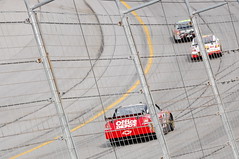 Image by fdtate via FlickrOn a typical NASCAR race weekend, Sprint Cup drivers will get some
practice time in and qualify Friday, followed by more practice Saturday
and the race on Sunday. Crewmembers can set up the cars for qualifying,
then dial in a race setup. For an impound race, NASCAR usually shifts
to Saturday qualifying, then impounds the cars from after qualifying
until the start of the race.
Image by fdtate via FlickrOn a typical NASCAR race weekend, Sprint Cup drivers will get some
practice time in and qualify Friday, followed by more practice Saturday
and the race on Sunday. Crewmembers can set up the cars for qualifying,
then dial in a race setup. For an impound race, NASCAR usually shifts
to Saturday qualifying, then impounds the cars from after qualifying
until the start of the race.


